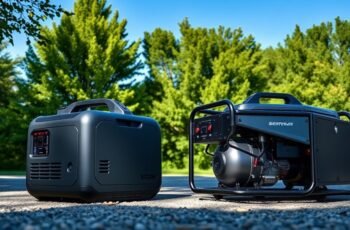
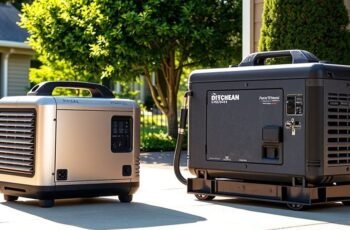
When evaluating backup power solutions, we recognize that both inverter and standby generators serve specific needs, yet their cost-effectiveness depends on factors like household size, outage frequency, and budget constraints. Understanding how each system operates and their long-term reliability can influence decision-making, but the nuanced differences often lead to questions about which provides ideal value. Exploring these options more closely can clarify which generator aligns best with your operational priorities and financial considerations.
Key Takeaways
- Standby generators provide automatic, whole-house backup during prolonged outages, justifying higher initial and maintenance costs.
- Inverter generators are portable, cost-effective for short-term use, and produce cleaner power for sensitive electronics.
- Standby units are more durable and reliable for continuous, heavy-duty power needs; inverters excel in portability and quiet operation.
- The choice depends on household size, power demand, outage duration, and budget considerations.
- Balancing upfront investment against long-term reliability and convenience determines which option offers better value.
How Do Inverter Generators Work and What Are Their Benefits?
While inverter generators may appear similar to traditional portable models, their core technology distinguishes them profoundly. They utilize advanced electronics to convert AC power into DC and then invert it back to clean, stable AC power. This process enables precise control over engine speed, which directly enhances fuel efficiency by adjusting output based on demand. Consequently, inverter generators consume less fuel compared to conventional units, making them more economical for extended use. Additionally, their design minimizes noise levels markedly, thanks to variable engine speeds and sound-dampening enclosures. This combination of high fuel efficiency and quieter operation makes inverter generators ideal for sensitive environments and portable applications. Overall, their innovative technology offers a compelling balance of energy conservation and low noise, setting them apart from traditional models.
What Are Standby Generators, and How Do They Provide Automatic Power?
Standby generators automatically activate during power outages, ensuring uninterrupted supply through integrated transfer switches. They typically run on natural gas or propane, though some models support diesel fuel, offering flexibility in installation. These systems are designed for seamless integration with home electrical setups, enabling automatic power restoration without manual intervention.
Automatic Power Activation
Automatic power activation is a defining feature of standby generators, enabling them to seamlessly respond to power outages without human intervention. This process relies on sensors that monitor utility power, triggering the generator to start within seconds of an outage. Once activated, the generator supplies power directly to the home’s electrical system, ensuring uninterrupted operation. Maintenance requirements are minimal but essential to keep automatic transfer switches and control systems functional. Noise levels can vary depending on the model, with some units operating quietly enough for residential settings, while others produce more sound during startup. Overall, automatic power activation provides reliable, immediate backup power, but considerations like maintenance and noise levels influence long-term performance and suitability for different environments.
Fuel Source Options
Fuel source options are fundamental to how standby generators operate and determine their efficiency, reliability, and environmental impact. They typically use fuels such as natural gas, propane, or diesel, each affecting fuel efficiency and maintenance costs differently. Natural gas offers consistent fuel supply and lower emissions but may have higher installation costs. Propane provides cleaner burning and easier storage, though it might be less fuel-efficient. Diesel generators tend to deliver higher power output and fuel efficiency but incur increased maintenance costs due to engine complexity and soot buildup. Selecting a fuel source involves weighing these factors against your power needs and environmental considerations. Key points include:
- Natural gas offers low emissions but variable fuel costs
- Propane ensures cleaner combustion and ease of storage
- Diesel provides high fuel efficiency and power output
- Fuel costs influence long-term operational expenses
- Maintenance costs vary with fuel type and generator design
Integration With Home System
Because they are designed for seamless operation, standby generators integrate directly with a home’s electrical system to provide automatic power during outages. This integration guarantees minimal disruption, activating within seconds of a power failure. Modern standby generators are engineered for high energy efficiency, optimizing fuel consumption to reduce operating costs. They also feature advanced noise level controls, maintaining quiet operation that minimizes disturbance in residential settings. The automatic transfer switch detects outages instantly, coordinating power flow without manual intervention. This system’s connection to the home’s electrical network allows for prioritized load management, ensuring critical appliances remain operational. Overall, the integration enhances reliability, safety, and efficiency, making standby generators a sophisticated backup solution for those seeking consistent, automatic power with minimal noise impact.
Comparing Costs: Are Standby Generators Worth the Investment?
When evaluating the cost-effectiveness of standby generators, it’s essential to take into account both upfront investment and long-term expenses. A thorough cost comparison reveals that initial installation costs are significant but often offset by reduced maintenance and fuel costs over time. Standby generators tend to have higher upfront prices, but their durability and automatic operation provide value for critical needs. Additionally, they generally have a lower environmental impact due to cleaner fuel combustion and efficient operation. Key factors influencing their worth include:
- Higher initial purchase and installation costs
- Lower ongoing fuel and maintenance expenses
- Increased reliability and automatic transfer features
- Reduced environmental footprint
- Potential insurance and tax incentives
Ultimately, whether a standby generator is worth the investment depends on your specific power needs and environmental priorities.
Which Backup Power Option Fits Different Home Sizes and Needs?
Selecting the appropriate backup power solution depends on accurately evaluating home size and power requirements. Larger homes with extensive electrical loads typically demand standby generators, while smaller residences may be sufficiently supported by inverter generators. Understanding these distinctions guarantees ideal system selection aligned with specific energy demands.
Home Size Considerations
How does the size of your home influence the choice between an inverter generator and a standby generator? Larger homes require higher energy capacity, making standby generators more suitable due to their ability to power entire households efficiently. For smaller homes or apartments, inverter generators offer energy efficiency and lower noise levels, which are advantageous in confined spaces. When considering home size, key factors include:
- Energy efficiency: Smaller homes benefit from inverter generators’ optimized fuel use.
- Noise levels: Inverter units produce less noise, ideal for close neighbors.
- Power capacity: Larger homes demand the robust output of standby generators.
- Installation complexity: Standby generators involve permanent setup; inverters are portable.
- Operational costs: Inverters often have lower initial costs but may lack the capacity for larger homes.
Choosing the right option hinges on aligning these factors with your home’s size and energy demands.
Power Needs Matching
Matching your backup power solution to your home’s specific energy needs requires careful assessment of load demands and capacity requirements. Inverter generators excel in energy efficiency and low noise levels, making them suitable for smaller homes and sensitive electronics. Conversely, standby generators provide higher capacity, ideal for larger homes with extensive power loads. To guarantee optimal fit, consider the following:
| Home Size | Power Needs | Ideal Generator Type |
|---|---|---|
| Small | Low | Inverter |
| Medium | Moderate | Inverter or Standby |
| Large | High | Standby |
| High Energy Efficiency | Critical | Inverter |
| Noise-sensitive Areas | Important | Inverter |
This approach guarantees energy efficiency and minimizes noise intrusion, aligning your backup power with your home’s unique demands.
How Reliable Are Inverter vs. Standby Generators During Power Outages?
During power outages, the reliability of inverter and standby generators hinges on their design and operational characteristics. Inverter generators excel in fuel efficiency, often consuming less fuel during variable loads, and produce lower noise levels, enhancing their dependability in residential settings. Standby generators, however, are typically more robust, offering continuous power regardless of load fluctuations, but may have higher fuel consumption and noise output. Key factors influencing reliability include:
- Fuel efficiency during sustained operation
- Noise levels affecting placement and user comfort
- Engine durability under prolonged use
- Automatic transfer switch responsiveness
- Maintenance schedules ensuring consistent performance
Both types are reliable when properly maintained, but standby units generally provide more consistent power during extended outages, while inverter generators are best suited for shorter, less demanding outages.
Pros and Cons of Portable Inverter Generators for Emergency Power
Portable inverter generators offer a versatile and efficient solution for emergency power needs, balancing portability with advanced power output quality. Their compact design allows easy transport and setup, providing portable power during outages or remote situations. They produce cleaner, stable electricity suitable for sensitive electronics, a key advantage over traditional generators. However, noise levels can vary markedly; many models operate quietly, but some produce disruptive sound, which could be a concern in quiet residential areas. Their fuel efficiency and ability to run for extended periods are notable pros, but limited runtime and lower power capacity compared to standby generators restrict their use for whole-home backup. Overall, portable inverter generators excel in flexibility and clean power, but their size, noise levels, and capacity constraints must be carefully considered for emergency preparedness.
The Advantages and Disadvantages of Standby Generators for Whole-Home Backup
Standby generators provide reliable, automatic power restoration for entire homes during outages, making them a popular choice for all-encompassing backup solutions. They offer seamless shift and continuous power supply, guaranteeing critical systems remain operational. However, they have notable disadvantages.
- Noise levels: Standby generators can produce significant noise, potentially disturbing occupants or neighbors.
- Maintenance requirements: Regular servicing is essential to ensure reliability, including oil changes and system checks.
- Installation complexity: Proper installation requires professional expertise, often involving significant upfront costs.
- Cost: These units tend to be expensive initially and for ongoing maintenance.
- Fuel dependency: They rely on propane or natural gas, which may not be available or convenient for all users.
Understanding these factors helps evaluate their practicality for whole-home backup needs.
Which Backup Generator Is Right for Your Budget and Lifestyle?
Choosing the right backup generator depends on evaluating your specific budget constraints and how your household’s lifestyle aligns with available options. Fuel efficiency is a critical factor, influencing ongoing operational costs; inverter generators typically offer higher efficiency and lower fuel consumption, making them suitable for extended use. Noise levels also notably impact suitability, especially in residential areas—standby generators tend to operate louder, which could be disruptive, whereas inverter models are considerably quieter. Consider your energy needs: if you require power for essential appliances during outages, a compact inverter generator may suffice, offering portability and efficiency. For whole-home coverage with minimal operational concern, a standby generator provides automatic backup but at a higher initial and maintenance cost. Balancing these factors ensures an ideal fit for your budget and lifestyle.
Frequently Asked Questions
What Maintenance Is Required for Inverter and Standby Generators?
We perform routine oil changes, filter replacements, and inspect electrical connections for both inverter and standby generators. Their fuel efficiency varies with usage, and installation complexity influences maintenance efforts, making regular checks essential for ideal, reliable performance over time.
How Long Can Each Type of Generator Operate Continuously?
While inverter generators run efficiently for several hours due to fuel efficiency and portability, standby generators operate continuously for days, offering reliable backup power, but with higher fuel consumption and less mobility.
Are There Noise Level Differences Between Inverter and Standby Generators?
We find inverter generators typically have lower noise levels, offering quieter operation with sound levels around 50-60 dB, whereas standby generators tend to produce higher noise levels, often exceeding 65-70 dB, due to their larger engines and ventilation.
Can Inverter Generators Power High-Demand Appliances Effectively?
We find inverter generators effectively power high-demand appliances due to their superior fuel efficiency and portability considerations, ensuring reliable performance for essential devices, though they may require careful load management for ideal operation under peak demand.
What Safety Features Are Common in Inverter Versus Standby Generators?
We find inverter generators often feature safety measures like overload protection and low-oil shutoff, enhancing fuel efficiency and portability options, while standby generators emphasize automatic shutoff and transfer switches for reliable, automated safety during power outages.
Conclusion
Ultimately, choosing between an inverter and standby generator hinges on your specific needs. While inverter generators offer portability and quiet operation for short-term use, standby units provide unmatched reliability for extended outages. It’s a balancing act—cost versus convenience, mobility versus automation. We weigh the technical benefits against the lifestyle implications, recognizing that the right choice depends on whether flexibility or seamless power delivery takes precedence in your home.