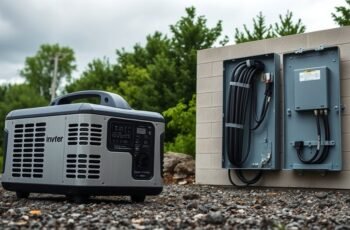
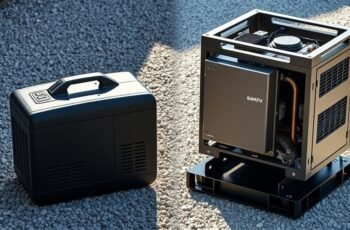
Think of choosing between an inverter generator and a home battery backup as selecting the right tool for a demanding job—each has its strengths and trade-offs. While inverter generators offer immediate, portable power, their ongoing fuel and maintenance costs can outweigh initial savings. Conversely, home batteries require a larger upfront investment but promise lower operational costs and longer-lasting reliability. Understanding these differences is essential for making a decision that balances cost, performance, and long-term value—considerations that are more intertwined than they initially appear.
Key Takeaways
- Home batteries typically have higher upfront costs but lower ongoing maintenance and fuel expenses, offering better long-term ROI.
- Inverter generators are more flexible for immediate power needs but have higher operational costs and noise levels.
- Batteries provide silent, stable power suitable for long outages, while generators respond quickly but produce fluctuating power and noise.
- Environmental impacts differ: generators emit fossil fuels, while batteries involve resource extraction and manufacturing challenges.
- Installation and usability favor batteries for ease of use and integration, whereas generators require more space, fuel management, and noise mitigation.
How Do Inverter Generators and Home Battery Backups Differ in Cost?
When comparing the costs of inverter generators and home battery backups, it’s essential to take into account not only the initial purchase price but also the long-term expenses associated with each. Fuel efficiency plays a significant role in inverter generators’ ongoing costs, as their fuel consumption directly impacts operational expenses over time. Conversely, home battery backups typically have lower operational costs due to their reliance on stored energy, but initial investment can be substantial. Noise levels also influence overall cost considerations; inverter generators tend to produce more noise, which may require additional soundproofing or insulation, adding to expenses. In contrast, battery backups operate silently, reducing ancillary costs. Overall, understanding these factors helps clarify the true long-term financial implications of each option.
Which Offers Better Performance for Power Reliability?
When evaluating power reliability, we focus on stability during outages, the consistency of power quality, and response times to surges. Inverter generators often provide immediate power restoration but may fluctuate with engine speed, while home batteries typically deliver steady, high-quality power. Understanding these differences helps determine which system better guarantees continuous, reliable energy supply.
Power Stability During Outages
Power stability during outages is a critical factor in evaluating inverter generators and home battery backups, as each system responds differently to fluctuating grid conditions. In regards to maintaining consistent power, home batteries often excel due to their ability to deliver stable, clean energy without interruption, regardless of external fluctuations. Inverter generators, while capable of providing reliable power, depend heavily on fuel efficiency and engine stability, which can impact their performance during prolonged outages. Battery lifespan affects long-term reliability, with deeper discharges potentially reducing operational capacity. Conversely, fuel efficiency impacts inverter generator runtime and overall stability during extended outages. Key considerations include:
- Voltage regulation consistency
- Response to load fluctuations
- Impact of battery lifespan on backup duration
- Fuel efficiency’s role in outage duration
Consistent Power Quality Levels
Evaluating power quality levels reveals significant differences in how inverter generators and home battery backups deliver stable, reliable electricity. Inverter generators typically produce power with fluctuating voltage regulation, which can introduce noise and transient variations affecting sensitive devices. Conversely, home battery backups offer superior power quality by providing consistent voltage regulation through advanced inverter technology, ensuring minimal fluctuation. This stability results in cleaner, more reliable power output essential for critical electronics. Battery systems maintain a steady output regardless of load changes, reducing the risk of power dips or surges that can compromise device performance. Overall, for consistent power quality levels, home battery backups outperform inverter generators, delivering a stable, high-quality power supply vital for sensitive equipment and long-term resilience.
Response Time to Surges
Response time to surges is a critical factor in evaluating power reliability, as it determines how quickly a backup system reacts to sudden electrical disturbances. Inverter generators typically have faster response times, often within milliseconds, allowing them to stabilize power without noticeable disruption. Home batteries, however, may take slightly longer to detect and respond to surges, which can impact sensitive equipment. Noise levels are also relevant; inverter generators generally produce more noise during rapid response, affecting usability in quiet environments. Portability factors influence how swiftly a system can be deployed or adjusted during a surge.
- Inverter generators react almost instantaneously, minimizing power dips.
- Home batteries respond slightly slower, risking short-term instability.
- Noise levels impact placement and immediate response effectiveness.
- Portability affects the speed of system deployment during emergencies.
What Are the Long-Term Cost Savings and ROI of Each Option?
While both inverter generators and home battery backups involve upfront investments, their long-term financial benefits differ considerably. Inverter generators offer fuel efficiency that reduces ongoing operational costs, especially during frequent use, translating into lower energy expenses over time. Their energy storage capacity, however, is limited, impacting overall ROI when compared to battery systems. Conversely, home battery backups provide a stable energy storage solution with minimal fuel costs, which enhances cost savings in the long run. Although initial installation costs are higher for batteries, their low maintenance and absence of fuel expenses improve overall ROI. Over extended periods, the reduced operational costs and increased reliability of energy storage make home batteries a more economically advantageous choice for sustained power backup, despite higher upfront investments.
How Do Installation, Maintenance, and Usability Compare?
Installation, maintenance, and usability are key factors influencing the practicality of inverter generators versus home battery backups. Inverter generators typically pose installation challenges due to their size, fuel requirements, and noise levels, which can complicate integration into residential setups. Conversely, home battery backups often require minimal installation effort but may face usability limitations related to capacity constraints and grid compatibility. Maintenance for inverter generators involves regular fuel and oil management, increasing ongoing costs. In contrast, batteries generally demand less upkeep but have limited lifespan and replacement cycles.
- Installation challenges: fuel setup and noise concerns for generators, minimal setup for batteries
- Usability limitations: capacity and runtime restrictions for batteries, fuel dependency for generators
- Maintenance complexity: routine servicing versus battery degradation
- User experience: ease of use and integration into existing systems
In What Situations Is an Inverter Generator the Better Choice?
In situations where portability, high power output, or fuel independence are priorities, inverter generators often present a superior solution. Their portable efficiency allows for easy transportation and setup in remote or outdoor environments, making them ideal for camping, construction sites, or emergency scenarios. In addition, inverter generators typically feature lower noise levels compared to traditional generators, which is vital in residential or noise-sensitive settings. Their ability to deliver stable power with clean sine waves also benefits sensitive electronics, ensuring minimal risk of damage. While they may have higher upfront costs, their compact design, fuel autonomy, and reduced noise make them a strategic choice where mobility and quiet operation are essential. These attributes collectively position inverter generators as the preferred option in dynamic, off-grid, or transient applications.
When Should You Opt for a Home Battery Backup Instead?
We should consider a home battery backup when long-term cost savings and sustained backup duration outweigh initial investments. Additionally, if integrating with solar power is a priority, batteries offer seamless energy management. Evaluating these factors helps determine when a battery backup is the more strategic choice.
Long-Term Cost Savings
Considering the long-term financial implications, choosing a home battery backup becomes increasingly advantageous when evaluating total operational costs over time. Battery lifespan and fuel efficiency are key factors influencing overall savings. Home batteries typically have longer lifespans with minimal degradation, reducing replacement frequency. Their high fuel efficiency eliminates ongoing fuel costs associated with inverter generators, which consume fuel continuously during use. Additionally, lower maintenance costs contribute to cost savings over the years. When analyzing ROI, the initial investment in a home battery system often offsets the cumulative expenses of portable generators, especially in areas with frequent outages.
- Longer battery lifespan reduces replacement frequency
- Superior fuel efficiency cuts ongoing operational expenses
- Lower maintenance costs enhance long-term savings
- Steady performance minimizes unexpected expenses
Backup Duration Needs
Evaluating your backup duration needs is vital when determining whether a home battery backup is the right choice. Unlike portable generators, batteries offer consistent, silent backup power, which is advantageous for extended outages. Fuel efficiency isn’t a concern with batteries, but their capacity directly impacts how long they can sustain critical systems. If your power disruptions last several hours or more, a home battery backup ensures seamless operation without noise pollution or fuel management. Conversely, for short-term outages, inverter generators may be more practical, especially when considering fuel efficiency. Noise levels are also a key factor; batteries operate silently, making them ideal for environments where noise restrictions are important. Ultimately, evaluating your typical outage duration guides the most suitable choice for reliable, efficient backup power.
Integration With Solar
When deciding whether to integrate a home battery backup with your solar system, it’s essential to assess your energy management goals and the extent of your renewable energy adoption. A battery’s chemistry influences longevity and safety, while inverter efficiency impacts overall system performance. Opting for a backup is advantageous if maximizing renewable energy use, reducing grid dependence, or enhancing resilience during outages is a priority.
Consider these factors:
- Compatibility with existing solar inverters and system architecture
- Battery chemistry suitability for your climate and usage patterns
- Inverter efficiency and its effect on energy storage and retrieval
- Long-term ROI, factoring in installation costs and operational lifespan
Choosing a battery backup becomes particularly relevant when optimizing for energy independence and system efficiency.
What Are the Hidden Costs and Limitations to Consider?
While inverter generators and home battery backups both serve to guarantee power resilience, they come with hidden costs and limitations that often go unnoticed during initial assessments. Environmental impact is a key consideration, as inverter generators typically burn fossil fuels, contributing to emissions, whereas batteries involve resource-intensive manufacturing processes with complex supply chains. Manufacturing complexity also influences long-term costs: batteries require rare materials like lithium, which pose sustainability challenges, while inverter generators involve durable components susceptible to wear and tear. Additionally, maintenance costs can escalate unexpectedly; generators need regular fuel and oil management, while batteries degrade over time, reducing efficiency. Understanding these overlooked factors helps balance immediate affordability with environmental responsibility and long-term operational viability.
Frequently Asked Questions
How Do Inverter Generators and Home Batteries Impact Environmental Sustainability?
Inverter generators generally have a higher carbon footprint due to fossil fuel use, while home batteries support renewable energy integration, reducing overall environmental impact. Both options influence sustainability, but batteries promote cleaner, more renewable energy solutions.
Can Inverter Generators or Home Batteries Be Integrated With Solar Power Systems?
Imagine a solar-powered home integrating a battery backup and inverter generator; this setup enhances fuel efficiency and reduces noise levels. Such integration optimizes energy use, ensuring reliable, sustainable power for critical loads during outages or peak demand periods.
What Safety Concerns Are Associated With Each Backup Option?
We analyze safety, noting inverter generators pose fire risks due to fuel handling, and noise levels can cause hearing damage, while home batteries involve electrical hazards from high voltage, emphasizing proper installation and ventilation to mitigate safety concerns.
How Quickly Can Each System Restore Power After an Outage?
Coincidentally, both systems restore power rapidly—generators typically start within seconds, influenced by fuel efficiency and noise levels, while home batteries activate almost instantaneously, providing seamless backup with minimal delay, ensuring continuous power supply during outages.
Are There Any Warranty or Support Differences Between the Two Options?
We find that inverter generators often come with extensive warranty comparisons and robust support services, whereas home battery backups may have limited warranties and support options. Both require careful evaluation based on reliability and service coverage.
Conclusion
Ultimately, choosing between an inverter generator and a home battery backup is a pivotal decision that hinges on your specific needs and long-term goals. While generators might seem like the quick fix, batteries offer a sustainable, cost-effective powerhouse that can redefine your backup resilience. With advancements in technology, the gap narrows each year—making this choice a critical, strategic investment in your home’s energy future. We believe this decision can be as transformative as a lightning strike—powerful and eye-opening.