Studies show that over 70% of outdoor enthusiasts rely on portable power solutions for extended trips, highlighting the importance of choosing the right device. When comparing inverter generators to car power inverters, the decision hinges on factors like power capacity, efficiency, and operational duration. Understanding these differences is essential for optimizing performance in camping and travel scenarios, but determining which option truly fits your needs requires a closer look at their technical distinctions.
Key Takeaways
- Inverter generators provide higher power output and stable electricity, ideal for powering multiple devices during extended camping trips.
- Car power inverters are portable and cost-effective for small device use but have limited capacity for larger appliances.
- Inverter generators are quieter and more fuel-efficient, suitable for longer durations and environments needing minimal noise.
- Car inverters are quick to set up and lightweight, perfect for short-term, mobile power needs on the go.
- For sustained, reliable power with higher capacity, inverter generators are generally the better choice for camping and travel.
What Are Inverter Generators and Car Power Inverters?
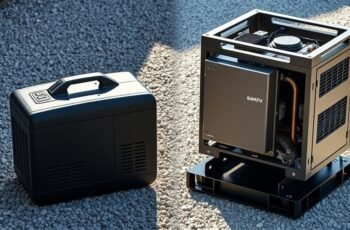
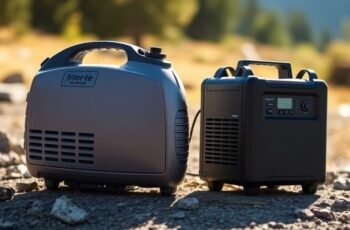
What exactly distinguishes inverter generators from car power inverters? Inverter generators are sophisticated power sources that use advanced battery technology and electronic components to produce stable, clean AC power. They incorporate inverter modules that convert DC power into sine wave AC, offering consistent voltage and frequency, which is critical for sensitive electronics. These generators are designed to minimize noise levels, making them suitable for quiet environments like campsites. In contrast, car power inverters rely on the vehicle’s battery and alternator, converting DC to AC with simpler circuitry. While they’re portable and convenient, their noise levels tend to be higher, and their power output is generally limited. Understanding these technical differences helps determine which device suits specific camping or travel needs.
How Do Inverter Generators and Car Power Inverters Work?
Both inverter generators and car power inverters convert direct current (DC) into alternating current (AC) to power devices, but they employ different mechanisms to do so efficiently. Inverter generators generate AC through electronic oscillation and inverter circuits that optimize power output, while car inverters rely on switching components to rapidly convert DC to AC. Understanding these conversion processes reveals how each system maximizes energy efficiency and maintains stable power delivery.
Conversion of DC to AC
To convert direct current (DC) into alternating current (AC), inverter generators and car power inverters employ electronic circuitry that rapidly switches the polarity of the DC input, creating a pulsating waveform. This process relies on high-speed switching components like transistors and MOSFETs, which modulate the voltage and current flow. Advanced inverter designs incorporate sophisticated pulse-width modulation (PWM) techniques, producing a smoother, more sinusoidal AC output suitable for sensitive electronics. Battery technology plays an essential role, especially in portable inverters, affecting efficiency and runtime. Additionally, the quality of the conversion impacts noise pollution, with better circuitry reducing electromagnetic interference and acoustic noise. This precise control of waveform and voltage stability ensures reliable power delivery, making inverters suitable for a variety of camping and travel applications.
Power Output Mechanisms
Inverter generators and car power inverters generate AC power through different but related mechanisms that rely on converting DC input into a stable, usable AC waveform. Inverter generators typically use a built-in engine and alternator to produce AC power, which is then converted to DC, filtered, and inverted back to clean, sine-wave AC output. This process guarantees high-quality power with minimal noise levels and improved battery compatibility when integrated with external batteries. Conversely, car power inverters primarily rely on the vehicle’s 12V DC supply, employing high-frequency switching circuits to directly convert DC to AC. While both systems enable device operation, inverter generators often provide more stable, quieter output suited for sensitive electronics, whereas car inverters may produce more noise and fluctuation, impacting battery efficiency and device safety.
Energy Efficiency Methods
Energy efficiency in inverter generators and car power inverters primarily depends on their power conversion and regulation techniques. Both devices utilize advanced inverter circuitry to generate stable AC power from DC sources, minimizing energy loss during conversion. Battery storage plays a critical role, especially in inverter generators, by buffering power demands and enabling smoother output regulation, which reduces wasted energy. Car inverters often integrate renewable energy sources, like solar panels, to optimize energy use and boost efficiency. Precise modulation of output voltage and frequency ensures minimal harmonic distortion and maximizes overall efficiency, particularly during variable loads. These methods collectively enhance energy conservation, making both systems more suitable for extended use in camping and travel scenarios where conserving power and integrating renewable energy are priorities.
Comparing Power Output and Efficiency for Camping and Travel
When comparing power output, inverter generators generally provide higher capacity and continuous wattage, making them suitable for larger appliances. Car power inverters tend to have lower efficiency levels, especially under heavy loads, but are more portable for quick, smaller-scale power needs. Understanding these differences helps determine which system better suits specific camping and travel scenarios.
Power Capacity Differences
How do inverter generators and car power inverters compare in regard to power output and efficiency for camping and travel? In terms of power capacity, inverter generators generally provide higher continuous wattage, supporting multiple devices simultaneously, which is advantageous for longer trips. Car power inverters tend to have lower wattage limits, suitable for smaller gadgets or essential electronics. Regarding efficiency, inverter generators often operate more smoothly, preserving battery lifespan and reducing wear, though they may produce higher noise levels. Conversely, car inverters are quieter but less efficient under heavy loads, potentially impacting battery longevity if used extensively. These differences influence overall performance, with inverter generators better suited for sustained power needs and managing noise levels, while car inverters excel in portability but may limit power capacity.
Efficiency Levels Comparison
In evaluating efficiency levels, it’s important to compare how inverter generators and car power inverters perform under typical camping and travel conditions. Inverter generators generally provide higher overall power output with better battery longevity due to optimized energy conversion. Car power inverters, while less efficient, are designed for quick power delivery but often consume more battery energy, impacting longevity. Noise levels also influence efficiency; inverter generators tend to operate more quietly, conserving energy and reducing fatigue. The table below highlights key differences:
| Aspect | Inverter Generator | Car Power Inverter |
|---|---|---|
| Power Output | Higher, suitable for appliances | Lower, best for small devices |
| Battery Longevity | Extended, due to efficiency | Reduced, from higher energy use |
| Noise Levels | Quieter, energy conserving | Louder, less efficient |
| Efficiency | Higher overall | Lower overall |
Usage Suitability Variations
Choosing the appropriate power solution depends heavily on the specific demands of camping or travel scenarios. Inverter generators typically offer higher power output, making them suitable for extended use and multiple devices, but they consume more fuel and impact battery longevity over time. Car power inverters, on the other hand, provide lower output but are highly portable and efficient for quick, smaller tasks. When comparing efficiency, inverters generally have a lower environmental impact due to cleaner energy conversion, but their efficiency varies with load. For camping, where power needs are moderate, car inverters can be sufficient and conserve battery life. Conversely, inverter generators excel in situations requiring sustained power, though they may exert more environmental strain. Selecting between them hinges on balancing power demands with sustainability considerations.
Practical Benefits and Limitations of Each Power Source
Both inverter generators and car power inverters offer distinct practical benefits and face specific limitations when used as portable power sources. Regarding advantages, inverter generators provide substantial battery storage capacity, enabling extended use without external power. They also tend to operate at low noise levels, making them suitable for camping environments. Conversely, car power inverters are lightweight and portable, easily connecting directly to a vehicle’s electrical system for quick setup. However, their limitations include limited power output, restricting their use to smaller devices, and potential fluctuations in power quality. Additionally, car inverters lack dedicated noise control and tend to produce higher noise levels during operation. Understanding these factors helps determine which power source aligns best with specific camping or travel needs.
Which Option Is More Cost-Effective and User-Friendly?
When evaluating cost-effectiveness and user-friendliness, inverter generators generally present a more economical long-term investment despite higher upfront costs, thanks to their durability and fuel efficiency. A detailed cost comparison reveals that, over time, inverter generators incur lower operational expenses due to their optimized fuel consumption and reduced maintenance needs. Their design prioritizes quiet operation and stable power output, which enhances the user experience by minimizing noise and providing reliable electricity. Conversely, car power inverters typically have lower initial costs but may lead to higher expenses through increased fuel use and potential equipment wear. Ultimately, inverter generators offer a more user-friendly solution with a smoother, more predictable power supply, making them a more cost-effective choice for extended camping or travel scenarios.
Making the Right Choice for Your Outdoor Adventures
Selecting the appropriate power source for outdoor adventures hinges on evaluating specific needs and environmental conditions. To optimize camping comfort and guarantee travel safety, consider these factors:
- Power stability and noise levels, as inverter generators typically offer cleaner, quieter electricity conducive to peaceful camping.
- Portability and ease of setup, where car power inverters excel due to their compact design and quick installation.
- Energy demands, with inverter generators providing higher wattage suitable for extended power needs, while inverters suffice for charging small devices.
Frequently Asked Questions
Can Both Devices Power Sensitive Electronics Safely During Camping Trips?
Yes, both devices can power sensitive electronics safely if they offer stable voltage output and low noise levels. We analyze their voltage stability and noise characteristics to guarantee minimal risk of damage or performance issues during camping trips.
How Portable Are Inverter Generators Compared to Car Power Inverters?
Inverter generators are less portable, but offer better fuel efficiency and lower noise levels, making them ideal for extended camping stays. Car power inverters are more compact and lightweight, enhancing portability for quick trips and minimal gear.
What Maintenance Is Required for Inverter Generators Versus Car Power Inverters?
We monitor fuel efficiency and noise levels, regularly checking and cleaning inverter generators for peak performance, while ensuring car power inverters stay cool and free of dust, requiring minimal maintenance for consistent, efficient operation during camping and travel.
Are There Environmental Impacts Associated With Each Power Source?
Environmental impacts, like emissions and resource use, are significant; inverter generators emit more pollutants due to fuel combustion, while car power inverters consume less but still draw power, influencing overall ecological footprints during camping and travel.
Which Option Offers Better Durability in Harsh Outdoor Conditions?
We find inverter generators offer superior durability comparison and outdoor resilience, thanks to their robust build, cooling systems, and protective casing, making them better suited for harsh outdoor conditions compared to the more fragile, less weather-resistant car power inverters.
Conclusion
Ultimately, choosing between an inverter generator and a car power inverter depends on your camping needs. Imagine the steady hum of a reliable inverter generator powering your campsite as the stars twinkle above, versus the quick, portable boost from a car inverter for a small device. Both have their merits, but for extended, stable power, inverter generators provide a seamless, efficient solution—turning your outdoor experience into a smooth, uninterrupted adventure.