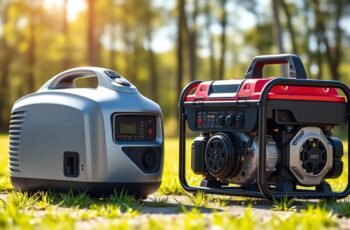
When evaluating inverter generators versus battery backup systems, we recognize both options have distinct financial implications over time. Inverter generators often require lower initial investment but incur ongoing fuel and maintenance costs, whereas batteries demand higher upfront spending with minimal operational expenses. Understanding which choice offers true cost savings depends on specific usage patterns and long-term needs, prompting a closer analysis of their performance and value in various scenarios. The decision isn’t straightforward, and exploring these factors can reveal what truly benefits your budget.
Key Takeaways
- Batteries have higher upfront costs but lower ongoing expenses due to no fuel or maintenance requirements.
- Inverter generators are cheaper initially but incur fuel, oil, and maintenance costs over time.
- Batteries offer silent, maintenance-free operation, reducing long-term operational costs.
- Generator costs depend on fuel prices and usage, impacting overall long-term savings.
- Cost-effectiveness varies based on power needs, usage frequency, and environmental conditions.
How Do Inverter Generators and Battery Backup Systems Work?
While inverter generators and battery backup systems both serve to provide portable power, their operational mechanisms differ markedly. Inverter generators generate electricity by combusting fuel, converting mechanical energy into AC power, and then refining it through an inverter for clean, stable output. They often feature solar compatibility, allowing integration with solar panels for eco-friendly operation. Noise levels are typically moderate but can vary depending on load and design. Conversely, battery backup systems store electrical energy in rechargeable batteries, releasing power as needed via inverter circuits. These systems are silent during operation and inherently solar-compatible, making them ideal for quiet, renewable setups. The core distinction lies in their energy source reliance: generators require fuel, while batteries depend on stored energy, affecting their suitability for different scenarios.
Comparing Initial Costs: Which Option Saves You More at the Start?
When comparing initial costs, we focus on purchase prices, installation expenses, and upfront benefits. Inverter generators generally have higher upfront costs but lower installation requirements, while battery backup systems often involve significant initial investments with varying installation needs. Analyzing these factors helps determine which option offers better immediate savings based on your specific setup and budget constraints.
Purchase Price Differences
Initial purchase costs for inverter generators typically range from $500 to $2,500, depending on size and power output, whereas battery backup systems often start around $1,000 and can exceed $10,000 for high-capacity units. While inverter generators may seem more affordable initially, their fuel efficiency and noise levels often lead to higher ongoing costs over time. Conversely, battery backup systems demand a significant upfront investment but eliminate fuel costs and reduce noise pollution.
- Feel confident with a reliable power source that minimizes long-term expenses
- Avoid surprise expenses from fluctuating fuel prices
- Experience quieter operation that won’t disturb your environment
- Secure a scalable solution that adapts to your energy needs
These factors make initial investment a vital consideration in your decision-making process.
Installation Expenses
Evaluating installation expenses reveals significant differences that can influence your overall investment. Inverter generators generally require minimal setup, mainly involving fuel connections and ventilation, leading to lower initial costs. Conversely, battery backup systems often involve complex electrical wiring, potential solar integration, and site preparation, increasing installation expenses. Solar integration can add upfront costs but offers long-term savings, while the noise levels of inverter generators can necessitate additional soundproofing measures, further raising initial expenses. Battery systems typically operate quietly, reducing the need for noise mitigation. Overall, inverter generators tend to have lower installation costs upfront, but when factoring in solar integration options for battery backups, initial costs can become comparable. Careful assessment of these factors is essential for an accurate cost comparison.
Upfront Cost Benefits
Evaluating upfront costs between inverter generators and battery backup systems reveals clear financial advantages for inverter generators, especially in initial investment. Inverter generators typically require a lower upfront expense due to their simpler technology and widespread availability. While battery backup systems involve higher costs driven by battery lifespan and advanced components, they often have longer-term savings through superior fuel efficiency and reduced maintenance.
- Immediate affordability, making it accessible for most budgets
- Lower initial investment costs, easing financial strain
- Faster deployment, saving time and resources
- Predictable expenses with minimal surprise costs
Inverter generators offer a cost-effective solution initially, but it’s crucial to weigh long-term operational savings. The higher upfront cost of batteries can be offset by their durability and efficiency benefits over time.
Analyzing Ongoing Expenses: Maintenance, Fuel, and Electricity Costs
When comparing inverter generators and battery backup systems, understanding their ongoing expenses is essential for making an informed decision. Inverter generators require regular maintenance, such as oil changes and filter replacements, along with fuel costs that fluctuate with usage and fuel prices. They often support solar integration, enhancing grid independence but increase operational costs if fuel consumption rises. Conversely, battery backup systems have minimal maintenance needs and no fuel expenses, relying primarily on electricity costs for recharging. Over time, electricity costs for battery systems may be influenced by grid dependency if solar integration isn’t sufficient. A thorough analysis of these ongoing expenses reveals that battery backups can offer predictable, lower operating costs, whereas inverter generators may incur higher fuel and maintenance costs, impacting long-term savings.
Assessing Reliability and Performance in Different Scenarios
To accurately compare inverter generators and battery backup systems, we need to evaluate how each performs during power outages and under heavy loads. Reliability in emergency scenarios is critical, so we’ll examine their consistency, responsiveness, and ability to sustain essential functions. This analysis helps determine which system offers superior performance and dependability across diverse situational demands.
Performance in Power Outages
Have you ever wondered which backup power source remains more dependable during an extended outage? When evaluating performance, inverter generators excel in providing immediate, high-wattage power, especially with solar integration options, but they generate noise levels that can be disruptive. Battery backup systems deliver silent, consistent power, ideal for sensitive electronics, yet may struggle to meet high load demands over time.
Consider these factors:
- Reliability: Battery systems offer consistent, maintenance-free operation, while generators depend on fuel supply.
- Noise Levels: Battery backups operate silently, whereas inverter generators produce noticeable sound.
- Solar Integration: Batteries easily integrate with solar setups, enhancing sustainability.
- Performance in Prolonged Outages: Batteries excel in steady, quiet power, but generators provide robust, immediate backup when needed most.
Reliability Under Heavy Load
Evaluating reliability under heavy load reveals distinct strengths and limitations of inverter generators and battery backup systems. Inverter generators typically offer high load capacity, maintaining stable power output, but prolonged heavy use can reduce battery lifespan and strain engine components. Conversely, battery backup systems excel with lower to moderate loads but may struggle under sustained heavy demand, risking system shutdowns or reduced performance. The load capacity directly impacts reliability; exceeding it accelerates component wear or triggers safety shutoffs. A comparison table highlights these aspects:
| System Type | Load Capacity | Battery Lifespan Impact |
|---|---|---|
| Inverter Generator | High, suitable for continuous heavy loads | Lower, due to engine strain |
| Battery Backup System | Moderate, ideal for short-term heavy loads | Can degrade with repeated heavy use |
Suitability for Emergency Use
Evaluating the suitability of inverter generators and battery backup systems for emergency use requires a careful analysis of their reliability and performance in critical scenarios. Battery lifespan directly impacts how long backup power remains available, especially during prolonged outages. Inverter efficiency influences how effectively each system converts stored energy into usable power, affecting runtime and energy management. In emergency situations, dependability is paramount; inverter generators tend to perform reliably under fluctuating loads, while batteries may experience capacity drops over time. Factors such as the robustness of the system’s design and the ability to sustain power output under stress determine overall performance.
- Confidence in continuous power supply during crises
- Resistance to extreme environmental conditions
- Long-term operational stability
- Immediate readiness when disaster strikes
Understanding Long-Term Value and Total Cost of Ownership
When comparing inverter generators and battery backup systems, understanding their long-term value requires analyzing both initial investment and ongoing operational costs. Battery lifespan and inverter longevity considerably influence total cost of ownership. Battery systems, while more expensive upfront, generally have longer lifespans—often 8-15 years—reducing replacement frequency. Conversely, inverter generators tend to have shorter lifespans, requiring more frequent maintenance and part replacements, which can escalate costs over time. Operational costs also differ: fuel consumption for generators versus electricity costs for batteries. To evaluate long-term value, consider the table below:
| Aspect | Battery Backup Systems | Inverter Generators |
|---|---|---|
| Initial Cost | High | Moderate |
| Maintenance | Low | Moderate to high |
| Lifespan | 8-15 years | 5-10 years |
| Operational Cost | Electricity | Fuel |
| Replacement Frequency | Less frequent | More frequent |
Which System Is Better for Home Use? Pros and Cons Explained
Choosing between inverter generators and battery backup systems for home use depends on specific needs and priorities, as each offers distinct advantages and limitations. Inverter generators excel in providing portable power with high wattage output, but their noise levels can be disruptive, and indoor safety concerns arise from exhaust emissions. Battery backup systems, on the other hand, prioritize indoor safety and quiet operation, making them ideal for continuous, silent power during outages. However, they typically have limited capacity and may require frequent recharging.
- Feel confident knowing your family’s safety is prioritized with silent, emission-free backup options
- Experience peace of mind from reduced noise levels during critical outages
- Rely on portable power that adapts to various home needs
- Minimize health risks associated with indoor emissions
Which Backup Option Is More Cost-Effective for Outdoor Adventures?
Considering the demands of outdoor adventures, determining which backup option offers better cost-effectiveness requires analyzing both initial investment and ongoing operational expenses. Inverter generators typically have higher upfront costs but provide reliable power with fuel efficiency, especially with solar integration options that reduce fuel expenses. Battery backup systems, especially those with portable design and solar compatibility, often involve lower initial costs and minimal maintenance. Solar integration enhances both systems’ cost-effectiveness by decreasing reliance on fuel or grid power. For extended trips, portable battery systems with solar panels tend to be more economical over time, given their lower operational costs. Conversely, inverter generators may be more suitable for short-term, high-power needs, but with higher ongoing expenses. Ultimately, the choice hinges on adventure duration, power needs, and budget constraints.
Environmental Impact and Cost Savings Over Time
When comparing inverter generators and battery backup systems, emissions and pollution levels are key factors influencing environmental impact. Energy efficiency benefits can lead to significant long-term cost savings, especially with advanced inverter technology. Analyzing these aspects helps determine which option offers sustainable operation and economic advantages over time.
Emissions and Pollution Levels
Inverter generators generally produce lower emissions and pollution levels compared to traditional fuel-based generators, making them a more environmentally friendly option. They emit fewer greenhouse gases, aligning better with renewable energy goals and reducing the carbon footprint. Additionally, their design minimizes noise pollution, which benefits both urban and natural environments. From an analytical perspective, inverter generators use advanced electronics to optimize fuel combustion, resulting in cleaner emissions. This efficiency not only reduces environmental impact but also contributes to long-term cost savings by complying with strict emissions regulations.
- Lower greenhouse gas emissions help combat climate change
- Reduced noise pollution preserves natural habitats and community peace
- Compatibility with renewable energy systems minimizes reliance on fossil fuels
- Decreased air pollutants contribute to better public health
Energy Efficiency Benefits
Building on the environmental advantages of inverter generators, their superior energy efficiency further amplifies benefits by lowering operational costs and resource use. They optimize fuel consumption through advanced inverter technology, enabling precise power regulation. This efficiency supports solar integration, allowing seamless synchronization with renewable sources, and enhances grid independence by reducing reliance on traditional power grids. Consequently, inverter generators minimize waste and emissions over time.
| Feature | Impact |
|---|---|
| Solar Integration | Enables efficient renewable use |
| Grid Independence | Reduces dependency on grid supply |
| Fuel Consumption | Lowers operational costs |
| Resource Efficiency | Decreases environmental footprint |
Long-Term Cost Advantages
Over the long term, inverter generators offer significant cost savings and environmental benefits by reducing ongoing expenses and minimizing ecological impact. They support integration with solar power systems, enhancing renewable energy use and lowering reliance on fossil fuels. This promotes grid independence, which can substantially decrease utility costs over time. Additionally, inverter generators typically have higher fuel efficiency, leading to lower operational costs and fewer emissions. The durability and low maintenance of these systems further contribute to long-term savings. By contrast, battery backup systems, while initially more expensive, often result in lower ongoing costs due to fewer fuel-related expenses and zero emissions. However, the environmental impact of inverter generators remains more favorable when considering their compatibility with sustainable energy sources and the potential for long-term savings.
Factors to Consider When Choosing Between Inverter Generators and Batteries
When evaluating whether to choose an inverter generator or a battery backup system, several critical factors must be weighed to guarantee the right fit for your needs. Key considerations include battery lifespan, which impacts long-term maintenance costs and replacement frequency, and inverter capacity, determining the system’s ability to handle your power demands efficiently. Battery lifespan varies depending on usage cycles and quality, influencing overall durability and cost-effectiveness. Inverter capacity, on the other hand, must match your specific load requirements to ensure smooth operation without overburdening the system. Both factors are essential in appraising operational longevity, initial investment, and ongoing expenses, enabling you to make a more informed decision tailored to your power needs while optimizing long-term savings.
Real-Life Cost Savings Examples for Different Power Needs
Understanding the cost savings associated with inverter generators and battery backup systems requires analyzing various power needs through real-world examples. For instance, a homeowner relying on solar power for essential appliances can reduce grid dependence, making battery backup systems more cost-effective over time. Conversely, for frequent outdoor use or high power demands, inverter generators often prove more economical due to lower initial investment and fuel costs.
- A rural property minimizing grid reliance saves thousands annually with solar-powered battery backups.
- Emergency preparedness benefits from batteries, eliminating fuel expenses and maintenance costs.
- Remote work setups with variable loads favor inverter generators for their scalability and fuel efficiency.
- Long-term cost analysis shows batteries provide substantial savings in environments with consistent sunlight, decreasing reliance on grid power and reducing ongoing expenses.
Frequently Asked Questions
How Long Do Inverter Generators Typically Last Before Needing Replacement?
Inverter generators typically last 10,000 to 20,000 hours, depending on maintenance, fuel efficiency, and usage. They operate with lower noise levels, extending lifespan, but regular servicing is essential to guarantee peak performance and durability over time.
Can Battery Backup Systems Be Expanded for Higher Power Needs?
Yes, battery backup systems can be expanded for higher power needs through modular designs, increasing battery capacity, and combining units. This enhances power capacity and scalability, allowing tailored solutions for varying energy demands efficiently and cost-effectively.
Are There Hidden Costs Associated With Inverter Generator Maintenance?
We find that inverter generators have hidden costs like maintenance for fuel efficiency and noise level mitigation, which can increase over time, making them less cost-effective than initially perceived. Regular upkeep is essential for peak performance.
Which System Has a Lower Environmental Footprint Over Its Lifespan?
We believe battery backup systems generally have a lower environmental footprint over their lifespan, as they utilize renewable energy sources more efficiently and produce considerably fewer carbon emissions compared to inverter generators, which rely on fossil fuels.
How Do Weather Conditions Affect the Performance of Each Backup System?
Weather conditions are like unpredictable weather vanes; they impact inverter generators’ noise levels and solar compatibility, reducing efficiency. Battery backup systems generally withstand weather better, maintaining consistent performance regardless of rain, snow, or wind.
Conclusion
Ultimately, choosing the most cost-effective backup depends on our specific needs. Remarkably, studies show that batteries can reduce operational costs by up to 40% over a decade, mainly due to minimal maintenance and no fuel expenses. While inverter generators offer immediate affordability, long-term savings favor battery systems, especially with renewable integrations. Carefully analyzing usage patterns and total lifecycle costs ensures we select the solution that maximizes both reliability and financial efficiency.