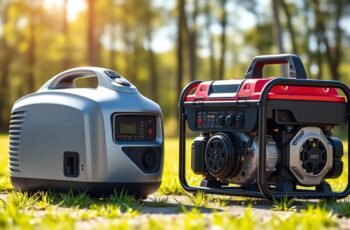
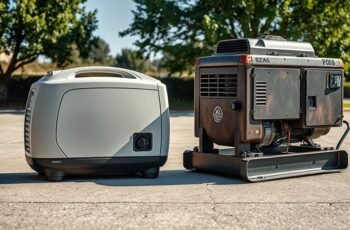
While inverter generators offer rapid power delivery suitable for high-demand applications, portable power stations emphasize quiet, stable output with slower recharge times. This fundamental contrast influences their suitability for different scenarios, yet understanding the nuances of charging speed and output capacity remains complex. As technology advances, the distinctions blur, prompting us to examine specific factors that determine which device best aligns with your power needs—an analysis that could redefine your expectations of portable energy solutions.
Key Takeaways
- Inverter generators typically offer faster refueling with high-capacity fuel tanks for quick turnaround, whereas power stations depend on slower external charging methods.
- Power stations generally have lower, steady output suited for sensitive electronics, while inverter generators can produce higher peak power for demanding devices.
- Inverter generators provide rapid refueling, making them ideal for extended use; power stations rely on external sources, with recharge times influenced by capacity.
- Portable power stations often use lithium-ion batteries enabling faster recharging through AC, solar, or vehicle adapters compared to traditional generators.
- Overall, inverter generators excel in quick refueling and high output, while power stations prioritize quiet operation and compatibility with renewable charging options.
How Do Inverter Generators and Portable Power Stations Differ in Charging Speed?
When comparing the charging speeds of inverter generators and portable power stations, it’s essential to recognize that their core mechanisms considerably influence how quickly they can be replenished. Inverter generators typically rely on fuel combustion, providing rapid power output but limited battery longevity during operation, which impacts overall recharge times. Portable power stations, on the other hand, use internal batteries that are charged externally via AC power or solar panels, resulting in slower charging speeds but potentially longer battery longevity through optimized charging cycles. Noise levels differ significantly; inverter generators tend to produce more noise during operation, affecting their usability in certain environments, while power stations operate silently during charging. These differences highlight how underlying technologies shape charging efficiency and operational considerations.
What Factors Affect Charging Speed in Both Devices?
Various factors directly influence the charging speed of both inverter generators and portable power stations, with technological specifications playing a central role. Battery technology markedly impacts charging efficiency; advanced lithium-ion batteries, for example, enable faster charging due to optimized chemistries and higher charge acceptance rates. Power conversion processes also affect speed; efficient inverters and chargers minimize energy loss during the transfer, accelerating recharge times. Additionally, the device’s input power capacity, including AC and DC charging options, determines how quickly energy is delivered. Factors such as internal circuitry design and thermal management influence overall efficiency, with superior engineering enabling faster, safer charging. Fundamentally, technological advancements in battery technology and power conversion systems are primary drivers of improved charging speeds.
Comparing Output Capacity: How Much Power Can You Expect?
When comparing output capacity, we focus on power output ratings, continuous power capacity, and peak power limits, which determine how much energy each device can deliver under different conditions. Understanding these metrics helps us assess their suitability for various applications, from running appliances to powering sensitive electronics. Analyzing these technical specifications allows us to predict real-world performance and reliability.
Power Output Ratings
Power output ratings are fundamental in determining a generator’s suitability for specific applications, as they directly indicate how much electrical power each device can supply. When comparing inverter generators and portable power stations, understanding their output capacities helps predict performance under load. Inverter generators typically offer higher peak power, suitable for running multiple appliances simultaneously, but may have limitations in sustained output. Portable power stations, often reliant on battery longevity, provide consistent but lower power levels, maximized for quieter operation with reduced noise levels. These ratings also impact overall efficiency; higher output capacity can increase noise levels and energy consumption. Consequently, evaluating power output ratings requires balancing the needed power against operational considerations like battery longevity and noise, ensuring the best choice for your specific power needs.
Continuous Power Capacity
Understanding the continuous power capacity of inverter generators and portable power stations is essential for evaluating their ability to sustain electrical loads over time. Inverter generators typically offer higher continuous wattage, making them suitable for longer-term operations, but their size can impact portability considerations. Portable power stations, powered by batteries, provide a different profile: their continuous output depends on battery longevity, which limits runtime without recharging. This makes them ideal for short-term or emergency use, especially when portability is a priority. When comparing the two, consider how their continuous power capacity aligns with your power needs, balancing the generator’s sustained output against the station’s reliance on battery capacity and portability considerations.
Peak Power Limits
While continuous power capacity determines how long devices can run steadily, peak power limits reveal the maximum instantaneous output each system can deliver during surges or startup moments. Peak capacity is critical for handling sudden power demands without compromising power stability. In inverter generators, peak power often exceeds continuous output by 20-30%, enabling smoother startup for high-inrush appliances. Portable power stations typically have lower peak capacities, limiting their ability to support devices with high initial loads. Comparing these limits helps us understand their suitability for specific applications, especially where power stability during surges is essential. By analyzing peak power limits, users can better anticipate performance during transient loads, ensuring reliable operation without risking overloads or voltage drops.
How Fast Can Inverter Generators Recharge Compared to Power Stations?
When comparing recharge times, we focus on charging efficiency and the flexibility of power sources. Inverter generators typically rely on fuel for immediate recharging, offering rapid turnaround but limited by fuel availability. Power stations, on the other hand, often recharge via AC power, which can be slower but allows for flexible, potentially renewable, charging options.
Charging Time Efficiency
How quickly can inverter generators and portable power stations recharge, and what does this mean for their practical applications? Recharging speed hinges on factors like battery chemistry and input power sources. Inverter generators typically rely on fuel, providing continuous operation rather than recharge cycles, but their ability to quickly refuel enhances operational efficiency. Portable power stations, on the other hand, utilize lithium-based batteries, whose recharge times vary based on chemistry; lithium-ion cells offer faster recharging—often within a few hours—compared to older chemistries. Portability considerations also influence recharge methods, as compact stations can be recharged via faster AC wall outlets or solar panels, but may require longer times due to limited input capacity. Overall, recharge efficiency impacts usability, especially in scenarios demanding rapid turnaround.
Power Source Flexibility
Inverter generators and portable power stations differ markedly in their recharging flexibility due to their fundamental energy sources. Inverter generators rely on fuel combustion, enabling rapid refueling but limited by environmental impact and fuel availability. Portable power stations utilize battery technology, which can be recharged via AC outlets, solar panels, or vehicle adapters, offering versatile recharging options.
- Faster recharging via AC power sources
- Solar panel compatibility for renewable energy
- Longer recharge times with larger batteries
- Environmental benefits of solar recharging
- Limited recharging speed with high-capacity batteries
These factors highlight that power stations provide greater flexibility, especially in remote or eco-conscious scenarios, whereas inverter generators prioritize quick refueling but with increased environmental considerations.
How Do Portable Power Stations Achieve Faster Recharges?
Portable power stations achieve faster recharges primarily through advanced battery management systems and high-capacity charging inputs. These systems optimize charging efficiency by precisely controlling current flow, which helps preserve battery longevity despite rapid recharges. High-capacity inputs, such as AC wall adapters or fast-charging ports, enable substantial energy inflow in shorter periods, reducing overall downtime. Technical innovations also minimize heat generation and noise levels during recharging, maintaining operational efficiency without compromising device longevity. Enhanced cooling mechanisms prevent overheating, further supporting quick recharges without degrading battery health over time. Overall, these integrated features allow portable power stations to recharge swiftly while balancing battery durability and maintaining low noise levels, making them suitable for both emergency and everyday use.
Which Device Delivers More Reliable Power Output?
While both inverter generators and portable power stations aim to provide stable power, inverter generators are generally more reliable in delivering consistent output due to their advanced inverter technology. Their ability to adapt to load changes ensures minimal fluctuations, which is vital for sensitive electronics. Factors influencing reliability include:
- Battery chemistry: Lithium-ion batteries in power stations offer stable discharge but can be affected by temperature variations.
- Noise levels: Inverter generators operate quieter, reducing noise-induced performance issues.
- Power stabilization: Inverter technology smooths out fluctuations, guaranteeing steady voltage and frequency.
- Engine design: Inverter generators’ engines are optimized for consistent output with less wear.
- Power quality: Both devices produce clean energy, but inverter generators excel in maintaining voltage stability under variable loads.
How Do Usage Scenarios Influence Your Choice of Charging Speed and Output?
Choosing the right power device depends heavily on the specific usage scenarios, particularly when it comes to charging speed and output capacity. For prolonged camping trips or emergency backup, a device with a higher output and faster charging capabilities guarantees reliable power, but may impact battery lifespan and generate more noise. Conversely, for frequent, low-demand usage, a quieter inverter generator might preserve battery health and reduce noise levels, enhancing overall longevity. Usage scenarios involving sensitive electronics demand stable, clean power with moderate output, favoring inverter generators. In contrast, high-demand applications require rapid charging and higher output, making portable power stations more suitable despite potential compromises in noise and battery longevity. Ultimately, balancing these factors is vital for optimizing device performance based on specific operational needs.
What Are the Pros and Cons of Each for High-Demand Devices?
When it comes to powering high-demand devices, each option presents distinct advantages and challenges that considerably impact performance. Inverter generators excel in handling high loads due to their robust power output and consistent sine wave, but they tend to generate higher noise levels, which may be disruptive. Portable power stations, depending on their battery chemistry, can provide cleaner, quieter operation with less noise, but often struggle with sustained high-demand power, especially if their inverter capacity is limited.
- Inverter generator: higher power output, better for continuous high loads
- Portable station: quieter operation, lower noise levels
- Battery chemistry: influences discharge rates and longevity
- Noise levels: critical for environments needing minimal disruption
- Performance trade-offs: between sustained demand and noise considerations
Which Device Is Better for Your Specific Power and Charging Needs?
Determining whether an inverter generator or a portable power station best suits your power and charging needs depends on your device demands and usage context. Inverter generators excel with higher power output and longer battery longevity, suitable for extended use, but tend to have higher noise levels. Portable power stations offer quieter operation and are ideal for low to moderate power needs, especially in noise-sensitive environments. Consider the following:
| Feature | Inverter Generator | Portable Power Station |
|---|---|---|
| Battery Longevity | Moderate to high | Usually higher |
| Noise Levels | Higher, variable | Lower, quieter |
| Power Output | Higher, suitable for heavy-duty | Moderate, ideal for charging small devices |
| Portability | Less portable | Highly portable |
| Usage Scenarios | Camping, backup power | Emergency, charging devices on-the-go |
Choose based on your priority for noise, longevity, and power needs.
Frequently Asked Questions
Which Device Is More Energy-Efficient During Prolonged Use?
We find portable power stations more energy-efficient during prolonged use, as they optimize battery life and minimize energy consumption. In contrast, inverter generators often consume more fuel and generate more heat, reducing overall efficiency over extended periods.
How Does Weather Impact Charging Speed and Output Stability?
Weather conditions considerably affect charging speed and output stability; as the saying goes, “A chain is only as strong as its weakest link.” Wind, rain, or cold cause power fluctuation, reducing efficiency and risking unstable energy delivery.
Are There Maintenance Differences Affecting Device Longevity?
We find that inverter generators require more frequent maintenance to guarantee ideal battery lifespan, while portable power stations typically need less maintenance, prolonging device longevity. Regular checks reduce wear and tear, maintaining consistent performance over time.
Can Both Devices Support Simultaneous Charging and Power Supply?
We find that both devices can support simultaneous charging and power supply, showcasing impressive charging versatility and advanced power management. This dual functionality enhances efficiency, but careful monitoring guarantees ideal operation and device longevity during concurrent use.
How Do Initial Purchase Costs Compare for Long-Term Savings?
We find inverter generators generally have higher initial costs but lower long-term operational expenses, making them a better investment over time. Portable power stations often require lower upfront costs, fitting tighter budgets but potentially incurring higher maintenance and replacement costs.
Conclusion
Ultimately, choosing between inverter generators and portable power stations hinges on your specific needs. Inverter generators excel in rapid recharging and high power output, ideal for demanding applications. Portable power stations prioritize quiet, stable power, trading off recharge speed for portability. As the saying goes, “You can’t have your cake and eat it too,” so evaluating your priority—speed or convenience—guides the best choice for your power and charging requirements.