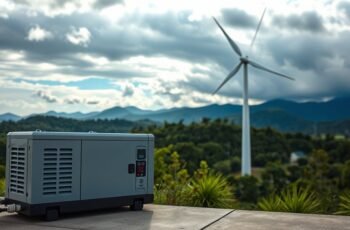
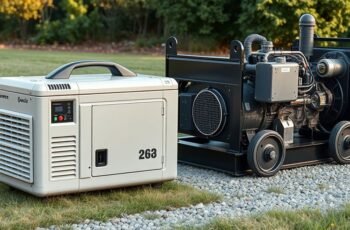
When evaluating off-grid power solutions, we recognize that both inverter generators and solar panels have unique advantages and limitations. Each system’s suitability depends on specific needs such as reliability, sustainability, and initial investment. To make an informed choice, it’s essential to analyze factors like cost, maintenance, environmental impact, and long-term scalability. Understanding these aspects thoroughly can help determine which option aligns best with a sustainable, efficient off-grid lifestyle.
Key Takeaways
- Solar panels offer renewable, emissions-free energy with minimal ongoing costs, ideal for long-term off-grid sustainability.
- Inverter generators provide immediate, reliable power suitable for variable or high-demand situations, but require fuel and maintenance.
- Solar energy is weather-dependent and needs storage, while generators perform consistently regardless of weather conditions.
- Solar systems have higher upfront costs but last 25–30 years with minimal maintenance, unlike generators with shorter lifespans.
- Scalability and long-term flexibility favor solar setups, whereas generators are more suitable for temporary or emergency power needs.
Understanding Off-Grid Power Needs: Solar Panels or Inverter Generators?
When evaluating off-grid power solutions, determining the specific energy demands of your application is essential, as this directly influences whether solar panels or inverter generators are more suitable. Key considerations include the required power output, duration of use, and system efficiency. Battery storage plays a critical role in managing intermittent energy supply from solar panels, enabling sustained operation during low sunlight or nighttime. Energy efficiency also impacts overall system viability; solar setups typically offer higher efficiency by converting sunlight directly into usable power with minimal losses. Conversely, inverter generators provide immediate power without storage but consume fuel continuously. Assessing your load profile and understanding how battery storage integrates into your energy system helps identify the most effective, sustainable approach for off-grid living.
How Do Inverter Generators Work and What Are Their Benefits?
Inverter generators operate by converting direct current (DC) produced by their internal engine into alternating current (AC) suitable for powering household appliances and sensitive electronics. This conversion process allows for stable and consistent power delivery, minimizing fluctuations that could damage delicate devices. Their design enhances fuel efficiency by adjusting engine speed to match load demands, reducing fuel consumption when power needs are low. Additionally, inverter generators are notable for their low noise levels, thanks to advanced sound-dampening technology and variable-speed operation. This quiet operation makes them ideal for off-grid settings where noise pollution is a concern. Overall, their combination of efficient fuel use, stable power output, and reduced noise levels makes inverter generators a reliable, portable energy source for off-grid living.
The Mechanics and Advantages of Solar Panel Systems for Off-Grid Living
Solar panel systems convert sunlight directly into electricity through photovoltaic cells, providing a sustainable and renewable power source for off-grid living. Their efficiency depends on best placement, inverter quality, and system design, including battery storage solutions. Battery storage enables energy from sunny periods to be stored for nighttime use, ensuring reliability. Grid integration, even in isolated settings, allows for hybrid systems that enhance stability and energy management. Key advantages include:
- Reduced reliance on fossil fuels
- Low operational costs after installation
- Scalability for varied energy needs
- Minimal maintenance requirements
- Improved energy independence and resilience
Comparing Cost, Maintenance, and Longevity of Inverter Generators and Solar Panels
Although both inverter generators and solar panel systems serve as reliable power sources, their costs, maintenance requirements, and longevity differ markedly. Inverter generators typically have lower initial costs but demand regular maintenance, including oil changes and parts replacement, limiting their lifespan to around 2,000–3,000 hours of operation. Solar panels require higher upfront investment, especially with integrated battery storage systems that enhance grid independence; however, they have minimal moving parts, resulting in lower ongoing maintenance. Solar panels generally last 25–30 years, providing long-term durability, whereas inverter generators often need replacement or significant repairs after 5–10 years. The choice hinges on balancing initial costs against long-term reliability, with solar systems offering extended longevity at the expense of higher initial investment.
Environmental Impact: Which Power Solution Is Greener for Off-Grid Homes?
When comparing environmental impacts, we focus on carbon emissions and the reliance on renewable energy sources. Solar panels produce minimal emissions during operation and harness renewable energy, offering long-term ecological benefits. In contrast, inverter generators generate higher emissions and depend on fossil fuels, which raises concerns about sustainability.
Carbon Emissions Comparison
Have you ever considered which off-grid power solution produces fewer carbon emissions over its operational lifespan? Inverter generators emit significant greenhouse gases due to fuel combustion, contributing to higher lifecycle emissions. Conversely, solar panels combined with battery storage generate clean energy, drastically reducing carbon footprints. Achieving grid independence with solar minimizes ongoing emissions, as there’s no need for fossil fuels.
Key points include:
- Inverter generators rely on fossil fuels, producing direct emissions.
- Solar panels produce zero emissions during operation.
- Battery storage allows for efficient energy use, reducing reliance on backup generators.
- Lifecycle emissions of solar are lower when considering manufacturing, installation, and disposal.
- Off-grid solar systems have a clear environmental advantage over traditional inverter generators for reducing overall carbon footprint.
Renewable Energy Sources
Renewable energy sources are fundamental to minimizing environmental impacts for off-grid homes, offering a sustainable alternative to conventional fossil-fuel-based systems. Solar panels harness sunlight, producing clean electricity with minimal emissions, while inverter generators, though often fossil-fuel powered, can integrate renewable energy storage solutions like batteries. Energy storage enhances system efficiency and guarantees grid independence during periods of low sunlight or fuel scarcity, reducing reliance on external power sources. Solar systems, when combined with advanced energy storage, provide a greener profile by eliminating emissions during operation. Conversely, inverter generators’ environmental footprint depends heavily on fuel type and efficiency. Overall, renewable energy sources that incorporate energy storage and promote grid independence considerably lower ecological impacts, making them the environmentally superior choice for off-grid living.
Long-Term Environmental Benefits
Despite the initial investment costs, solar panels generally offer superior long-term environmental benefits for off-grid homes due to their minimal operational emissions and renewable energy sourcing. Solar systems, combined with battery storage, enable sustained grid independence, reducing reliance on fossil fuels. This *considerably* lowers carbon footprints over time. Additionally, solar panels produce no local air or water pollution during operation, unlike inverter generators that emit greenhouse gases and particulate matter. The durability of solar infrastructure minimizes resource consumption in maintenance and replacements. *Furthermore*, utilizing solar energy promotes sustainable resource use and reduces environmental degradation. Key environmental advantages include:
- Reduced greenhouse gas emissions
- Elimination of fuel transport impacts
- Lower lifecycle pollution
- Enhanced resource conservation
- Support for renewable energy *shift*
Setup and Installation Considerations for Both Systems
When planning installation, we must consider site-specific factors such as available space and site readiness to guarantee ideal system performance. The complexity of setup varies considerably between inverter generators and solar panels, often requiring different tools and expertise. Additionally, compliance with permits and regulations can influence project scope, timing, and overall feasibility for both systems.
Space and Site Preparation
Selecting an appropriate site and preparing the space are critical steps in installing either an inverter generator or solar panels, as both systems have specific spatial requirements that influence performance and safety. Effective site selection considers site accessibility for maintenance and operation, ensuring ease of access for routine checks and repairs. Material durability is essential, especially in exposed environments, to withstand weather conditions without degradation. The site must also support proper ventilation for generators and ideal sunlight exposure for panels. Additionally, ground stability impacts installation integrity.
Key considerations include:
- Ensuring unobstructed access for maintenance
- Using weather-resistant materials
- Selecting level, stable ground
- Minimizing shading or obstructions
- Planning for future system expansion
Installation Complexity and Tools
Installing inverter generators and solar panels involves distinct technical procedures that require specific tools and careful planning. Both systems present unique installation challenges, especially related to tool requirements and spatial considerations. Inverter generators typically demand portable power tools, such as wrenches and screwdrivers, for securing the unit and connecting fuel lines, making their setup relatively straightforward. Conversely, solar panel installation involves mounting hardware, electrical wiring, and inverter integration, which require specialized tools like torque wrenches and multimeters. The following table summarizes these differences:
| Aspect | Inverter Generator | Solar Panels |
|---|---|---|
| Installation Challenges | Fuel connections, ventilation | Structural mounting, electrical wiring |
| Tool Requirements | Basic hand tools | Specialized electrical and mounting tools |
Permits and Regulatory Compliance
Managing permits and regulatory requirements is a critical aspect of deploying inverter generators and solar panels, as compliance guarantees safety, legality, and ideal system performance. A permits overview clarifies necessary approvals, while understanding regulatory hurdles prevents legal setbacks. Both systems often require specific permits: inverter generators may need noise or emission permits, whereas solar panels typically require electrical and structural approvals. Failing to comply can lead to fines or system removal. Key considerations include:
- Local zoning laws affecting installation
- Utility interconnection standards
- Building code compliance for structural modifications
- Certification of electrical components
- Inspection and approval processes
Navigating these regulatory aspects ensures smooth deployment and long-term system reliability, making permits overview and adherence to regulations essential for successful off-grid setup.
Reliability and Performance: Can Solar or Inverter Generators Meet Your Energy Demands?
While both solar panels and inverter generators are capable of providing reliable power, their ability to meet specific energy demands depends heavily on their performance characteristics and operational constraints. Solar systems rely on battery storage and consistent sunlight, which can limit power availability during cloudy days or at night. Inverter generators offer immediate, on-demand power with high power efficiency, making them suitable for variable loads.
| Aspect | Solar Panels | Inverter Generators |
|---|---|---|
| Battery Storage | Essential for reliability | Not required for basic operation |
| Power Efficiency | Dependent on sunlight and storage | High, with consistent fuel supply |
| Load Handling | Limited during low sunlight | Capable of meeting high power demands |
| Operational Constraints | Weather-dependent | Fuel-dependent, noise considerations |
| Performance Reliability | Moderate, with storage optimization | Consistent, immediate power supply |
Which System Offers More Flexibility and Scalability?
When evaluating flexibility and scalability, solar panels and inverter generators differ considerably in how easily they can adapt to changing energy needs. Solar systems excel in scalability through modular expansion—adding panels or enhancing energy storage capacity—integrating seamlessly with existing setups. Conversely, inverter generators offer rapid deployment and can be scaled up by deploying additional units, but their system integration is less flexible over time. Solar systems’ ability to incorporate advanced energy storage solutions provides long-term adaptability, whereas generator-based setups depend on fuel availability and maintenance.
- Modular design enabling incremental expansion
- Compatibility with diverse energy storage options
- Ease of system integration for solar setups
- Rapid scaling with additional generator units
- Limited flexibility in long-term system modifications
Making the Choice: Factors to Consider When Choosing Between Inverter Generators and Solar Panels
Choosing between inverter generators and solar panels hinges on evaluating several critical factors that align with your specific energy needs, environmental considerations, and budget constraints. Battery storage capacity plays an essential role, especially for solar systems, as it determines energy availability during low sunlight periods. Inverter generators typically offer high fuel efficiency, reducing ongoing operational costs, but they rely on fuel availability and infrastructure. Solar panels, while environmentally friendly and silent, require a significant initial investment and sufficient space. Consider your power consumption patterns: high, consistent loads favor inverter generators, whereas variable or intermittent needs suit solar setups with adequate battery storage. Ultimately, balancing fuel efficiency, upfront costs, and long-term sustainability will guide you toward the most suitable system for off-grid living.
Frequently Asked Questions
How Long Do Inverter Generators and Solar Panels Typically Last?
Inverter generators typically last 10-15 years with regular maintenance, while solar panels often endure 25-30 years, thanks to their durability comparison; maintenance mainly involves cleaning and occasional inspections, making solar panels more long-term efficient.
Can Inverter Generators and Solar Panels Be Used Together?
Yes, inverter generators and solar panels can work hand-in-hand through hybrid integration, creating energy synergy that enhances reliability and efficiency. This setup balances power sources, optimizing energy output and ensuring continuous off-grid power supply, even during low sunlight.
What Are the Safety Considerations for Each Power System?
We prioritize safety by regularly maintaining batteries, ensuring proper ventilation, and monitoring noise levels. For inverter generators, we prevent electrical hazards through proper grounding and avoid carbon monoxide buildup, while solar panels require secure mounting and electrical safety checks.
How Do Weather Conditions Affect Solar Panels and Inverter Generators?
Weather conditions impact solar panels like clouds dimming a spotlight, reducing efficiency and increasing maintenance challenges, while inverter generators handle weather resilience better but require more regular upkeep during storms or humidity fluctuations.
Which System Requires More Technical Knowledge to Operate?
We find inverter generators demand less technical knowledge, with simpler maintenance and operation, whereas solar panels require higher user skill levels for system setup, monitoring, and troubleshooting, making them more complex regarding maintenance intricacy and user proficiency.
Conclusion
Ultimately, our choice hinges on balancing benefits and boundaries. Solar’s sustainable, scalable system sustains self-sufficiency, while inverter generators deliver dependable, immediate power. We must weigh the longevity of long-lasting panels against the portability of quick-setup generators, considering costs, conditions, and commitments. By dissecting durability, demand, and environmental impact, we can determine the best balance—building a bespoke off-grid blueprint that blends brilliance with practicality.