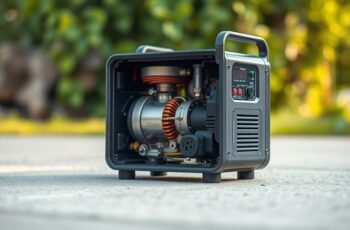
We comprehend how essential reliable power is, and we recognize that portable inverter generators operate through a complex process involving fuel conversion, power regulation, and advanced wave synthesis. They continuously balance engine speed, manage load variations, and produce high-quality electricity in a compact design. These technical features ensure consistent performance while minimizing noise and vibrations. To fully understand how these systems maintain stability and efficiency, it’s important to explore each component and its interplay within the generator’s operation.
Key Takeaways
- Portable inverter generators produce AC power via an internal combustion engine, which is then converted to DC and back to stable AC output.
- They use advanced electronic modulation and filtering to generate a pure sine wave, ensuring high-quality, stable power.
- Digital controls continuously monitor and adjust engine speed and output for efficiency and to match load demands.
- Their design includes safety features like automatic shutoff and overload protection for reliable operation.
- Compact, lightweight construction allows easy transport, making them ideal for outdoor, recreational, or emergency use.
How Do Portable Inverter Generators Generate Power?
Although portable inverter generators appear compact, their power generation process involves sophisticated electrical engineering principles. They utilize an internal combustion engine to produce AC power, which is then converted to DC and subsequently inverted back to clean, stable AC output. This process enhances fuel efficiency by adjusting engine speed to match the load demand, reducing unnecessary fuel consumption. Additionally, the inverter technology inherently contributes to noise reduction, as the engine operates at variable speeds rather than a constant high RPM. By dynamically adapting to power requirements, these generators minimize operational noise and optimize fuel use. This combination of precision control and efficient power conversion ensures that portable inverter generators deliver reliable, quiet, and economical electricity for various applications.
The Role of Inverter Technology in Power Quality
Inverter technology plays a vital role in enhancing power quality by providing a smoother, more stable output. It minimizes voltage fluctuations that can harm sensitive devices, ensuring consistent performance. This precision in power delivery is essential for safeguarding electronics and maintaining reliable operation.
Smoother Power Output
Because electrical devices are sensitive to fluctuations in power quality, ensuring a stable and consistent output is critical. Inverter technology achieves this by converting DC to AC power through sophisticated modulation, resulting in a smoother, cleaner sine wave. This stability minimizes voltage spikes and dips, protecting sensitive electronics from damage. Additionally, inverter generators optimize fuel efficiency by precisely adjusting engine speed based on load demands, which also contributes to consistent power. Proper battery maintenance further supports this process, ensuring reliable startup and steady operation. Visualize the following:
- A steady, ripple-free power stream safeguarding delicate electronics
- An engine that adjusts speed seamlessly, conserving fuel
- Reliable battery performance maintaining continuous operation
This combination of advanced inverter circuitry and intelligent system management guarantees superior power quality, making inverter generators ideal for sensitive applications.
Reduced Voltage Fluctuations
By precisely controlling the output frequency and voltage, inverter technology considerably reduces voltage fluctuations that can disrupt sensitive electrical devices. This regulation guarantees consistent power quality, which is vital for maintaining device performance and longevity. Reduced voltage fluctuations also optimize fuel efficiency, as the generator operates more smoothly without unnecessary surges or drops. Additionally, stable power output lessens strain on the battery, potentially extending battery longevity over time. The following table summarizes key impacts:
| Effect on Power Quality | Impact on Generator Performance |
|---|---|
| Minimizes voltage swings | Enhances fuel efficiency |
| Stabilizes voltage output | Supports battery longevity |
| Protects sensitive devices | Assures consistent operation |
| Improves overall reliability | Reduces wear and tear |
This technical control underscores inverter generators’ capacity for superior power stability.
Improved Sensitive Device Safety
How do inverter generators enhance the safety of sensitive electronic devices? They produce a stable, clean power output by utilizing advanced inverter technology, which minimizes voltage spikes and frequency variations. This stability is vital for delicate electronics like computers and medical equipment. Battery integration further refines power quality by buffering transient loads, ensuring consistent output. Additionally, inverter generators optimize fuel efficiency, reducing fluctuations in power delivery caused by inconsistent fuel consumption. They employ sophisticated digital controls to monitor and adjust output in real-time, maintaining a pure sine wave. Visualize a generator seamlessly balancing power, with the internal components dynamically responding to load demands, providing a safe environment for sensitive devices without risking damage or data loss.
How Engine Speed Affects Power Output and Efficiency
Engine speed directly influences both the power output and efficiency of portable inverter generators. Higher engine speeds typically increase power generation but also elevate fuel consumption and noise levels, impacting fuel efficiency and noise reduction efforts. Conversely, operating at lower speeds improves efficiency and reduces noise, though it may compromise power availability. Maintaining an ideal speed ensures a balance between sufficient power and operational efficiency.
| Engine Speed | Effect on Power & Efficiency |
|---|---|
| High | Increased power, higher fuel use, noise |
| Low | Improved fuel efficiency, quieter |
| Optimal | Balanced power, efficiency, noise |
| Excessively Low | Insufficient power, potential instability |
The Process of Converting DC to Clean AC Electricity
We start by rectifying the DC power into a pulsating current, which is then oscillated to mimic an AC waveform. This oscillation involves rapid switching of current direction, shaping a sine wave that approximates utility power. Finally, filtering circuits smooth out the waveform, removing ripples to produce clean, stable AC electricity suitable for sensitive devices.
Rectification of DC Power
The process of rectification is vital in converting the direct current (DC) produced by the generator’s internal components into alternating current (AC) suitable for household and industrial use. This conversion guarantees clean, stable power output necessary for sensitive electronics. During rectification, diodes or controlled switches transform the pulsating DC into a form that can be smoothed into a near-sinusoidal waveform. This step is fundamental for integrating with battery storage systems and solar inputs, which often supply DC power. The rectified AC can then be filtered and regulated to meet grid standards.
- Visualizing the flow of current through diodes, blocking reverse flow to guarantee unidirectional current.
- Understanding how smooth, stable power supports battery storage and solar integration.
- Recognizing the importance of precise rectification for consistent power quality.
Oscillation of Current
How does a portable inverter generator transform steady DC current into the alternating current that powers our devices? It employs an oscillation process driven by a high-frequency inverter circuit. This circuit rapidly switches the DC polarity, creating a fluctuating current with a specific oscillation frequency, typically around 60 Hz. The current amplitude is precisely controlled to match the desired voltage output, ensuring stable power delivery.
| Parameter | Description | Impact |
|---|---|---|
| Oscillation frequency | The rate at which current reverses | Determines AC cycle rate |
| Current amplitude | The magnitude of the oscillating current | Affects voltage stability |
| Switching speed | How quickly the inverter toggles polarity | Influences power quality |
This oscillation process is fundamental for converting DC into usable AC electricity.
Filtering for Clean Output
After generating the oscillating AC signal, the inverter circuit produces a raw output that contains unwanted noise and harmonic distortions. To guarantee the power is suitable for sensitive electronics, filtering processes are essential. We utilize advanced filter components, such as inductors and capacitors, to smooth out irregularities and produce a stable, clean sinusoidal wave. This filtering not only improves power quality but also enhances fuel efficiency by reducing energy losses. Modern inverter generators leverage sophisticated battery technology to maintain consistent output, minimizing fluctuations that could introduce noise. The result is a reliable, clean power supply that protects connected devices and optimizes overall efficiency. These filtering techniques are integral to delivering stable, high-quality AC electricity in portable inverter generators.
Why Inverter Generators Are Quieter Than Traditional Models
Because inverter generators utilize advanced power modulation technology, they inherently produce less noise compared to traditional models. This technology allows the generator to adjust its engine speed based on real-time energy storage demands, resulting in smoother and quieter operation. Unlike conventional generators that run at a constant speed, inverter models optimize fuel efficiency by modulating energy output, reducing engine RPM and noise levels. The streamlined energy storage process minimizes mechanical vibrations, further decreasing sound emissions. This precise control over engine operation not only enhances fuel efficiency but also markedly lowers acoustic footprint, making inverter generators ideal for noise-sensitive environments. Overall, the combination of adaptive power modulation and optimized energy storage contributes to their quieter performance relative to traditional models.
Understanding Voltage Regulation and Stability
Inverter generators achieve their efficiency and quiet operation partly through precise control of electrical output, which hinges on effective voltage regulation and stability. This regulation ensures consistent power delivery, safeguarding sensitive devices and maximizing overall performance. Stable voltage minimizes fluctuations that could damage electronics or reduce battery longevity. Additionally, consistent voltage regulation enhances fuel efficiency by allowing the generator to operate at ideal speeds, reducing unnecessary fuel consumption. Key mechanisms include automatic voltage regulation (AVR) systems, which monitor and adjust voltage in real time, and inverter technology that refines AC output. Visualize these systems as:
- A feedback loop constantly fine-tuning voltage levels
- Digital control panels displaying real-time voltage stability
- Compact components working seamlessly to maintain steady power flow
How Portable Inverter Generators Manage Load Changes
Portable inverter generators continuously monitor load demands and adjust power output in real time to maintain stability. Their smooth shift mechanism guarantees seamless changes in electrical load without disrupting the supply or causing fluctuations. This dynamic response is critical for providing consistent, high-quality power during varying usage conditions.
Real-Time Power Adjustment
When load demands fluctuate, portable inverter generators respond by dynamically adjusting their power output in real time. This process relies on sophisticated control systems that monitor energy storage levels and optimize fuel efficiency. As the load increases, the generator ramps up output, drawing from energy storage to stabilize power delivery. Conversely, when demand decreases, it reduces output, conserving fuel and maintaining efficiency. This real-time adjustment prevents overexertion of components and minimizes fuel consumption, ensuring continuous, stable power. Visualize this as a finely tuned system balancing energy storage and consumption, akin to a smart engine constantly recalibrating. The generator’s ability to adapt instantly enhances operational efficiency, reduces fuel waste, and prolongs lifespan—key factors for reliable, portable power solutions.
Smooth Transition Mechanism
As load demands shift rapidly, inverter generators deploy sophisticated mechanisms to guarantee seamless power delivery without sudden fluctuations. This is achieved through advanced control systems that dynamically adjust output frequency and voltage, ensuring stable operation. Battery storage units play a vital role in smoothing shifts, absorbing surges, and providing immediate power support during sudden load spikes. This integration enhances the generator’s ability to handle fluctuating demands efficiently. Additionally, the smooth transition mechanism facilitates renewable energy integration by balancing intermittent sources like solar or wind with consistent power output. These systems work in concert to prevent power disturbances, maintaining steady, clean electricity even during rapid load changes. This technical approach ensures reliability, efficiency, and compatibility with modern energy systems.
The Significance of Compact Design and Portability
Why does the compact design of inverter generators matter so much in practical applications? Primarily, it enhances portability, allowing users to easily transport equipment across varied environments. This design minimizes space requirements, facilitating storage and integration into tight spaces. Additionally, a smaller form factor often correlates with improved fuel efficiency, as optimized internal components reduce energy waste. The portability also simplifies battery maintenance, enabling quick access for charging or replacement without extensive disassembly. Visualize a lightweight unit with ergonomic handles, fitting seamlessly into vehicle trunks or tight campsites. Such design considerations ensure reliable power delivery in remote or emergency situations, emphasizing the importance of compactness for real-world utility and operational efficiency in diverse scenarios.
How Safety Features Ensure Reliable and Safe Operation
To guarantee safe and reliable operation, inverter generators incorporate a range of advanced safety features that actively monitor and protect the system. These include automatic shutdown mechanisms triggered by low oil levels or overheating, preventing damage and ensuring longevity. Safety features also regulate battery charging to avoid overcharging, which could lead to system failures or safety hazards. Additionally, these generators optimize fuel efficiency through intelligent load management, reducing fuel consumption and emissions while maintaining stable power output. This balance between safety and efficiency minimizes operational risks and extends the generator’s lifespan. By continuously controlling critical parameters, these safety measures assure consistent performance, safeguarding both the user and the equipment during extended use or variable load conditions.
Common Troubleshooting Steps for Inverter Generator Issues
When inverter generators encounter issues, systematic troubleshooting becomes essential to restore proper function and guarantee safety. Common problems often relate to fuel efficiency or noise reduction, impacting overall performance. To identify issues, we first check for fuel supply blockages or contaminated fuel, which can impair operation and reduce fuel efficiency. Next, we inspect the cooling and ventilation systems, as poor airflow can cause overheating and noise increase. Lastly, we verify the inverter’s electronic components for faults, ensuring stable power output. Visual cues like irregular vibrations, persistent noise, or decreased runtime signal underlying problems. Troubleshooting steps include cleaning fuel filters, clearing vents, and resetting circuit boards. These actions help maintain ideal fuel efficiency and noise reduction, ensuring reliable operation and prolonging the lifespan of the generator.
Frequently Asked Questions
What Maintenance Is Required to Keep Inverter Generators Running Efficiently?
We perform regular maintenance routines, including oil changes, filter replacements, and inspecting fuel efficiency components, to guarantee inverter generators run smoothly and efficiently. Consistent upkeep minimizes downtime and optimizes performance while preserving fuel economy.
How Long Can a Portable Inverter Generator Operate on a Single Fuel Tank?
We find that portable inverter generators typically provide a runtime of 8 to 12 hours on a single tank, depending on fuel efficiency and load. To maximize runtime extension, managing load and maintaining ideal engine conditions is essential.
Are Inverter Generators Suitable for Sensitive Electronic Devices?
We find inverter generators highly suitable for sensitive electronic devices due to their low noise levels and stable, clean power output, which also contributes to their fuel efficiency. This guarantees safe, reliable operation for delicate electronics.
How Does Altitude Affect Inverter Generator Performance?
Ever wondered how altitude impacts inverter generator performance? It affects power efficiency, requiring altitude adjustment to maintain ideal output, as thinner air reduces engine combustion efficiency, leading to decreased power generation at higher elevations.
Can Inverter Generators Be Connected in Parallel for Increased Power?
Yes, inverter generators can be connected in parallel for power scaling, allowing us to combine their outputs and increase total power capacity. This setup enables flexible, efficient power management, ideal for demanding applications requiring higher energy output.
Conclusion
In essence, the seamless operation of portable inverter generators results from a complex interplay of advanced inverter technology, precise engine control, and intelligent load management. This coincidence of engineering principles not only guarantees high-quality power but also enhances efficiency, noise reduction, and safety. As we’ve explored, their design integrates these elements to adapt dynamically to varying demands, making them indispensable for reliable, portable power solutions—highlighting how thoughtful engineering turns coincidence into consistent performance.